

In the aftermath of World War II, one of the proposals to revitalize the economy and the reputation of Sanremo was to create an annual music festival to be held in the city.
In 1948 and 1949, the first two editions of the Italian Song Festival (Festival della Canzone Italiana) were held in Viareggio, from an idea developed in 1947 by Aldo Valleroni. The competition was discontinued in 1950 due to financial problems, but it became the basis for the future Sanremo Music Festival
During the summer of 1950, the administrator of the Sanremo Casino, Piero Bussetti, and the conductor of the RAI orchestra, Giulio Razzi, rediscussed the idea, deciding to launch a competition among previously unreleased songs. Officially titled Festival della Canzone Italiana (literally “Festival of the Italian song”), the first edition of the show was held at the Sanremo Casino on 29, 30, and 31 January 1951. The final round of the competition was broadcast by Rete Rossa, the second most important RAI radio station. Twenty songs took part in the competition, performed by three artists only–Nilla Pizzi, Duo Fasano, and Achille Togliani.
Starting from the third edition of the festival, held in 1953, each song was performed by two different artists with different orchestras and arrangements. Two years later, in 1955, the festival made its first appearance on television, since part of the final night was also broadcast by RAI’s channel Programma Nazionale. The last night of the show was also broadcast in Belgium, France, Germany, the Netherlands, and Switzerland.
In 1964, Gianni Ravera, who organized the 14th Sanremo Music Festival, slightly changed the rules of the contest, requiring each song to be performed once by an Italian artist and once by an international singer, who was allowed to perform the song in any language. The same rule was applied in the following year’s contest. Between 1967 and 1971, entries were not forced to be interpreted by foreign artists, but double performances were kept. Starting from 1972, each entry was sung by one artist only.
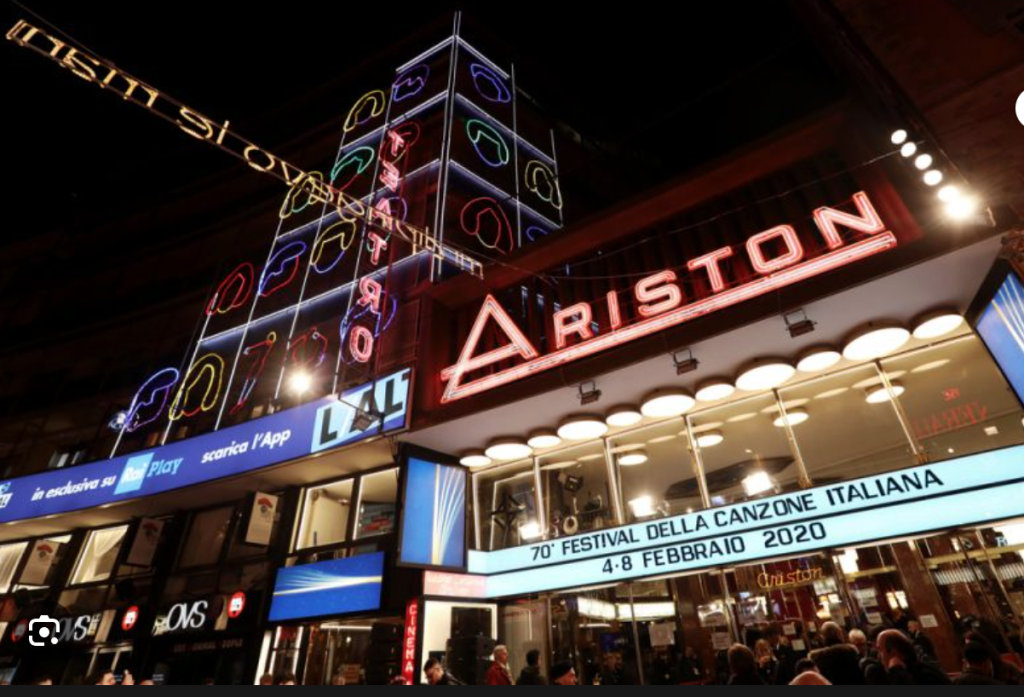
The Teatro Ariston has hosted the Sanremo Music Festival since 1977. The only exception was 1990’s contest, hosted at Sanremo’s Palafiori.
The competing artists were split for the first time into “Big artists” and “Young artists” during the Sanremo Music Festival 1974. The competition had one winner only, but the entries in the “Young artists” category had to go through an elimination round, while “Big artists” were directly admitted to the final round.
In 1977, the Sanremo Casino, which hosted all the previous editions of the contest, was closed for renovations, therefore the show moved to the Teatro Ariston. The theatre later became the usual location for the annual contest, hosting it every year except in 1990, when the show was held at the Nuovo Mercato dei Fiori, also known as Palafiori.
In 1980, pre-recorded backing tracks replaced the orchestra, while playback performances were allowed in 1983 during the final round. In 1984 and 1985, all the artists were forced to perform in playback, while live performances with the orchestra were reintroduced in 1990. During the same years, several other changes were introduced in the contest. In 1982, accredited music journalists decided to create an award to recognise the best song competing in the festival. Starting from 1983, the prize was officially awarded during the event. The Critics’ Prize was later named after Mia Martini, who was the first artist to receive it in 1982 for her entry “E non finisce mica il cielo”.
Moreover, starting in 1984, the separation between newcomers and established artists was marked, introducing two different competitions with separate winners. In 1989, a third category, the Upcoming Artists Section, was introduced, but it was removed the following year. Only in 1998 were the top three artists in the newcomer section allowed to compete in the main competition. This led to the victory of the debuting Annalisa Minetti, which generated some controversy and led to the reintroduction of completely separate competitions starting in 1999.
The distinction among different categories was abolished again in 2004. The following year, the contest included five different categories—Newcomers, Men, Women, Groups, and Classics. The winner of each category competed for the final victory of the contest. The category Classic was abolished in 2006 and starting in 2007, the festival came back to the rules used in the 1990s, with two completely separate competitions for established artists and newcomers.
In 2009, a new competition, held entirely online, was introduced by the artistic director of the 59th edition of the contest, Paolo Bonolis. Titled Sanremofestival.59, the contest was not held in the following years.